Why We're Building AgentiCraft: The Missing Infrastructure Layer for AI Agents
88% of AI pilots never reach production. The bottleneck isn't the models — it's the infrastructure around them. The story behind AgentiCraft and why we're building the layer that's missing.
The demo always works. Production never does.
I've spent the past several years thinking about distributed systems — how to make unreliable components work together reliably at scale. When I started applying that thinking to AI agents, I kept running into the same gap. Not an intelligence gap. An infrastructure gap.
This is the story behind AgentiCraft and the thesis we're betting on.
The Problem We Kept Hitting
Every team I talked to had the same story. They'd build a proof-of-concept in a few weeks. A single agent, maybe two, doing something genuinely impressive. Stakeholders would get excited. Timelines would get set. And then the real work would begin.
Not the AI work. The infrastructure work.
How do you trace a failure across a chain of ten LLM calls? How do you rotate API keys when you're hitting rate limits across three providers? How do you coordinate five agents that need to share context without stepping on each other? How do you prevent prompt injection at every entry point? How do you deploy, monitor, roll back, and do it all without a three-month detour into distributed systems engineering?
Most teams spend months answering these questions before shipping a single agent to production. Some never get there at all.
The numbers back this up. IDC found that 88% of AI proof-of-concepts fail to transition into production. MIT NANDA's 2025 report paints an even bleaker picture — only 5% of enterprise GenAI pilots achieved meaningful revenue impact. The problem isn't the models. The models are good enough. The problem is everything around them.
But there was a deeper problem than infrastructure alone. Even the teams that solved the infrastructure challenges — who built their own observability, their own deployment pipelines, their own security layers — still hit a wall. The wall was coordination.
Every multi-agent framework today assumes a hierarchy — a manager agent delegating to workers, a chain of command, a single point of control. It's the design every tutorial teaches. It's simple to reason about. And it creates three problems that compound as you scale:
Single point of failure. The manager agent dies, everything stops. No graceful degradation. No fallback path. Just a timeout and a pager alert.
Token bottleneck. The manager must process the full context from every agent to make routing decisions. At 10+ agents, the manager's prompt becomes the most expensive and slowest part of the system.
Scaling ceiling. Add more agents, and the manager becomes the bottleneck. It can't route, aggregate, and coordinate faster than the work arrives.
This isn't a LangChain problem or a CrewAI problem. It's an architectural problem. Every framework that defaults to hierarchical coordination inherits it.
What Microservices Already Learned
The frustrating part was that distributed systems engineering solved this exact class of problem a decade ago.
The progression from monolith to microservices to service mesh maps almost perfectly onto the progression from single agent to multi-agent to mesh-native coordination.
Monoliths were replaced by microservices. But microservices introduced their own coordination problem — how do you handle service discovery, retries, circuit breakers, load balancing, and observability across hundreds of independent services? The answer wasn't a centralized orchestrator. It was a service mesh.
Istio, Linkerd — these systems work because they embed coordination into the infrastructure itself. Every service gets a sidecar proxy that handles retries, rate limiting, auth, and tracing. A control plane manages policy centrally, but execution is fully distributed. No single point of failure. No central bottleneck.
The key insight: you don't need a central orchestrator if every node can discover, communicate with, and observe its peers.
Agents have the same topology as microservices. The same solutions apply.
The Mesh-Native Thesis
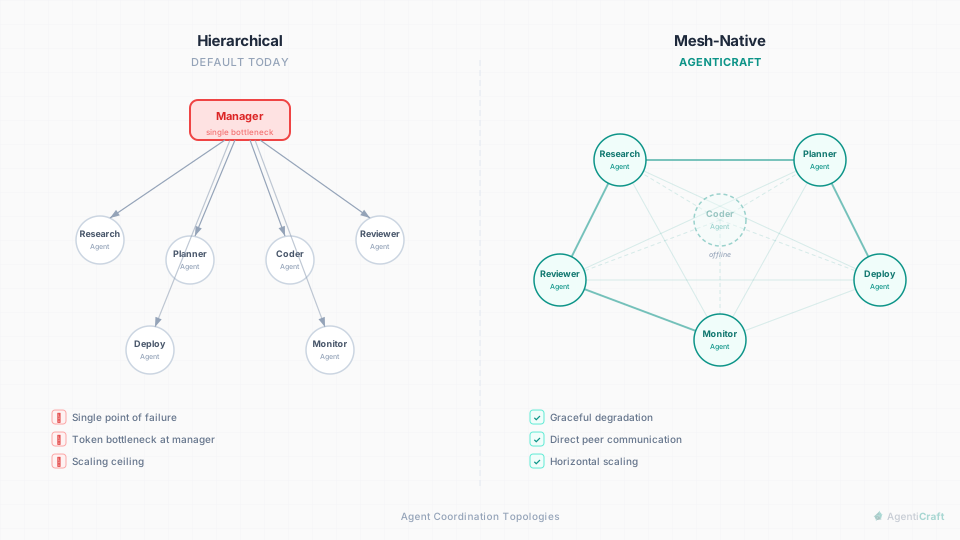
This is the thesis we're building AgentiCraft on:
Agents should coordinate as peers in a mesh topology by default, not as subordinates in a hierarchy.
What changes:
- No single point of failure — any agent can initiate coordination. The system degrades gracefully, not catastrophically.
- Token efficiency — agents communicate directly with the agents they need to reach. No manager tax on every message.
- Horizontal scaling — add agents without bottlenecking a central coordinator.
- Protocol-native — built on MCP and A2A from the ground up, not bolted on after the fact.
What doesn't change: you can still build hierarchical patterns on top of mesh. Hierarchy is sometimes the right choice — for small teams with clear task decomposition, it's hard to beat. Mesh-native doesn't eliminate hierarchy. It makes hierarchy one option among many, instead of the only option.
Here's the honest caveat: mesh coordination is harder to reason about than hierarchy. There's no single node that "knows everything." Debugging requires distributed tracing instead of reading one agent's logs. The mental model is more complex.
We think the trade-off is worth it for production systems at scale. For a 3-agent demo, it's probably not. We're building for the former.
What AgentiCraft Is (and Isn't)
AgentiCraft is the infrastructure layer between your agent logic and production. You write the intelligence. The platform handles coordination, reliability, observability, and cost control.
It ships with over 200 agent patterns across 18 categories — from reasoning and planning to multi-agent coordination, fault tolerance, and retrieval-augmented generation. These aren't templates. They're production-grade implementations you compose rather than reimplement.
Under those patterns sits a mesh of 40+ services with tiered SLAs — covering security, deployment, gateway, observability, agent management, and communication. The full operational stack an agent system needs to run reliably.
And because no one should be locked into a single provider, AgentiCraft supports 18 LLM providers behind a unified interface — OpenAI, Anthropic, Google, Mistral, Azure OpenAI, Ollama, and 12 more — with automatic failover and provider-level redundancy.
The whole system speaks MCP (Model Context Protocol) and A2A (Agent-to-Agent) natively. Your agents interoperate with the broader ecosystem from day one.
agent = (
    Craft.agent("research_analyst")
    .model("gpt-5.4", fallback="claude-sonnet-4-6")
    .pattern("react")
    .capabilities(["web_search", "code_execution", "data_analysis"])
    .mcp("github", "slack")
    .skill("deep_research")
    .memory("hierarchical")
    .guardrails(safety_checks=True)
    .circuit_breaker(threshold=5, timeout="30s")
    .retry(max_attempts=3, backoff="exponential")
    .rate_limit(requests_per_minute=60)
    .validation(output_schema=ReportSchema)
    .monitoring(track_costs=True, trace=True)
    .sandbox(isolation_level="strict")
    .build()
)
Automatic provider failover, a reasoning pattern, three capabilities in one call, MCP tool servers, a multi-step research skill, hierarchical memory, guardrails, circuit breaker that trips after five failures, exponential retry, rate limiting, output validation, cost tracking, tracing, and sandboxed execution — one builder, backed by the full mesh.
And because the whole point is that agents shouldn't coordinate through a central bottleneck:
team = (
    Craft.team("market_research")
    .agent(
        Craft.agent("researcher")
        .model("gpt-5.4")
        .pattern("react")
        .capabilities(["web_search", "data_analysis"])
        .mcp("github")
    )
    .agent(
        Craft.agent("analyst")
        .model("claude-sonnet-4-6")
        .pattern("chain_of_thought")
        .skill("financial_analysis")
    )
    .agent(
        Craft.agent("writer")
        .model("gemini-3.1-pro-preview")
        .pattern("reflection")
    )
    .coordination("mesh")
    .a2a(enabled=True)
    .consensus("majority")
    .failover(auto=True)
    .tenant("acme_corp")
    .monitoring(track_costs=True, trace=True)
    .build()
)

report = await team.run("Analyze Q4 market trends and draft recommendations")
Three agents, three providers, mesh coordination over A2A. No manager routing every message — each agent discovers its peers and communicates directly. The team reaches consensus without a single point of failure. If a provider goes down, failover kicks in automatically. And because the team is scoped to a tenant, data, API keys, and cost budgets are fully isolated.
The same capabilities work as decorators when you're extending base agents instead of building from scratch:
@circuit_breaker(threshold=5, timeout="30s")
@retry(max_attempts=3, backoff="exponential")
@tenant("acme_corp")
@monitor(track_costs=True, trace=True)
class ResearchAnalyst(Agent):
    model = "gpt-5.4"
    fallback_model = "claude-sonnet-4-6"
    pattern = "react"
    capabilities = ["web_search", "code_execution", "data_analysis"]
    mcp_servers = ["github", "slack"]
Fluent builder for composition, decorators for encapsulation — same infrastructure either way.
What AgentiCraft isn't: a replacement for LangChain's tool ecosystem, a no-code agent builder, or a hosted platform (yet). If you need the broadest set of pre-built tool connectors, LangChain has us beat. If you want the simplest API for role-based agent teams, CrewAI is genuinely easier to start with. We're building for the gap between "my agents work in a notebook" and "my agents run reliably in production at scale."
What We've Learned So Far
Building AgentiCraft has already taught us things that surprised us.
The most important finding from our research: in multi-agent systems, the dominant cost isn't what most people assume. When agents coordinate through natural language (the default in most frameworks), the token cost of coordination can exceed the token cost of the actual work. But when we dug into the data, coordination topology mattered less than we expected — it turned out that how agents formulate their reasoning, not how many hops their messages take, dominated total cost. We'll share the full breakdown in an upcoming post.
What surprised us most: the failures we hit in testing weren't agent failures — they were infrastructure failures. Timeouts from rate-limited providers. Lost state between conversation turns. Silent degradation when a service dependency went down. The agents were smart enough. The system around them wasn't reliable enough.
What we're still working through: how to make mesh coordination intuitive for developers who've only worked with hierarchical patterns. How to provide good defaults without being too opinionated. How to build observability that's genuinely useful, not just more dashboards.
What's Next
Three things converged to make this the right moment.
First, the models are good enough. ChatGPT, Claude, Gemini — we crossed the threshold where models can handle real agent workloads. The bottleneck shifted from model capability to infrastructure.
Second, the protocols are stabilizing. MCP from Anthropic and A2A from Google are becoming the standards for how agents use tools and talk to each other. You can build on stable foundations now, not shifting sand.
Third, the demand is real. Every major enterprise has an AI agent initiative. Most are stuck in pilot. The teams that break through won't be the ones with better models — they'll be the ones with better infrastructure.
Mesh-native is a bet. We think it's the right one for production multi-agent systems. This blog is where we'll share what we learn — patterns, failures, data, and honest trade-offs.
Next up: why the industry keeps building agent frameworks when the real gap is agent infrastructure — and what we think should exist instead.
If you're building multi-agent systems and hitting the same walls, you're our people. Join the waitlist for early access, or follow along here.
The demo will always work. We're building for what comes after.